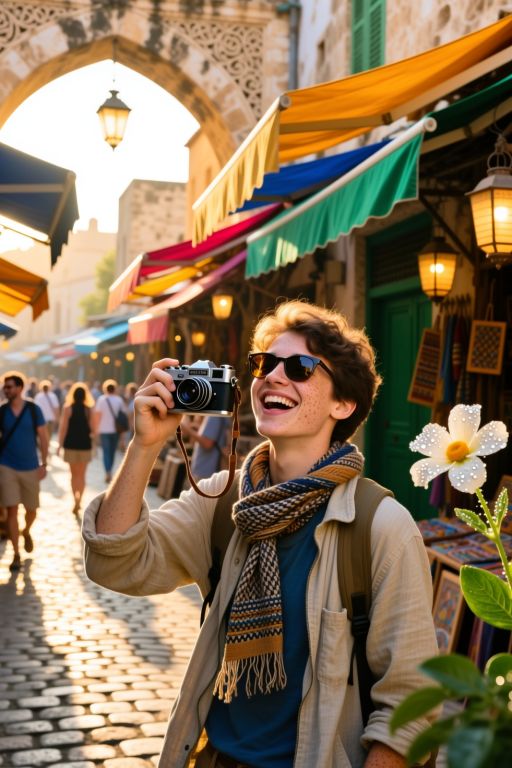
As "check-in style" tourism gradually fades, travelers' expectations for destinations have shifted from "I've been there" to "I've felt it." A truly immersive experience is no longer about hastily skimming past landmarks, but about deeply binding the senses, emotions, and local culture together. Today, a wave of phenomenal tourist destinations is using scene reconstruction and interactive design to make every visitor the protagonist of their own story.
Traditional sightseeing relies on single-point visual stimulation, while immersive experiences mobilize the multi-dimensional coordination of hearing, touch, smell, and even taste. Take the大唐不夜城 (Great Tang All Day Mall) in Xi'an as an example — visitors no longer just take photos in front of statues; they dress in Tang Dynasty-style hanfu and participate in a street drama through interactions with the "Roly-Poly Lady." The district uses lighting arrays, holographic projections, and real-time sound effects to compress the grandeur of the High Tang era into every inch of the pedestrian street, so that each step visitors take lands on the rhythm of history.
Behind this transformation lies a recalibration by operators of both "visitor dwell time" and "emotional memory points." Data shows that scenic areas incorporating immersive interactive elements see average visitor dwell time increase by approximately 1.8 hours, and the conversion rate of secondary spending grows by over 40%. When a visit becomes a participatory performance, tickets are no longer the sole revenue stream — ancillary spending on dining, cultural merchandise, and costume styling naturally rises along with it.
Take "Huitong Tianxia" (Connecting the World) launched at Pingyao Ancient City. Visitors enter as apprentices of a draft bank, gradually piecing together the business operations of Shanxi merchants by solving riddles, exchanging secret passphrases, and completing silver delivery tasks. Unlike traditional guide narration, every NPC (non-player character) has a fully developed persona and scripted dialogue logic, and each choice visitors make influences the direction of the storyline. The core of this model lies in "task-driven" engagement, allowing visitors to absorb knowledge through active exploration rather than passive reception.
The Shanghai production of "Sleep No More" transforms a derelict hotel into an immersive theater experience. Audience members wear masks and move freely across 90 rooms, observing actors' micro-expressions and physical nuances up close. This "boundless stage" breaks the fourth wall — viewers no longer sit in fixed seats but run, pause, and even engage in one-on-one interactions with the performers. For tourist destinations, such projects are typically linked with hotels and dining to create a closed-loop consumption cycle of "stay + performance + socializing."
In Xunpu Village, Quanzhou, visitors don floral hairpin wreaths and wide-sleeved traditional garments, learning from local elderly women how to build models of oyster-shell houses or experiencing the daily labor of Xunpu women. This "slow immersion" does not rely on high-cost technology; instead, it recreates authentic living scenes, allowing visitors to forge emotional connections through hands-on activity. Its advantages lie in low marginal costs and high revisit rates — every craft session yields a one-of-a-kind travel keepsake.
AR (Augmented Reality) and VR (Virtual Reality) technologies are blurring the boundaries between the physical and digital worlds. At the Mogao Caves in Dunhuang, visitors wearing AR glasses can "see" faded pigments on murals regain their brilliance, and even pose for photos with virtual flying Apsaras. At the Palace Museum's "Digital Polyptych" exhibit, viewers use gesture recognition to "pick up" artifacts and rotate them 360 degrees, with details more vivid than what the naked eye could perceive on the originals. These technologies are not meant to steal the show, but rather to serve as "magnifying glasses" or "time machines," helping visitors understand historical textures invisible to the naked eye.
It is worth noting that a quality immersive experience is not merely a stack of technologies. The industry consensus is that "technology serves the narrative" — over-reliance on special effects can actually fracture emotional resonance. Successful projects often adhere to the design principle of "one memory point per minute," using pacing to keep visitors in an optimal state of excitement balanced between surprise and immersion.
The core competitiveness of an immersive tourist destination lies in its "repeatability." To achieve this, operators must establish a content iteration mechanism. For example, Changsha's Super Wenheyou updates its themed scenes quarterly, shifting from nostalgic street life to cyberpunk aesthetics to keep returning customers intrigued. The Wuzhen Theatre Festival, meanwhile, curates a fresh lineup of international productions each year, giving theater enthusiasts an annual ritual to look forward to. In addition, social media dissemination is key to breaking out of niche circles — designing "camera-friendly" interactive touchpoints (such as light tunnels or oversized art installations) effectively encourages visitors to share spontaneously, generating secondary buzz.
For corporate clients, immersive venues also serve as ideal settings for team building and brand launches. Customized storylines, embedded brand elements, and team-based competitive missions can move collaboration from the conference room into a far more emotionally resonant real-world setting. The memory retention rate of such experiential training far exceeds that of traditional PowerPoint presentations.
The next stage of competition will no longer be confined to individual scenic spots or projects, but will center on crafting an immersive atmosphere across an entire city or region. Luoyang, for instance, is advancing a "citywide scripted mystery game" initiative, linking over a dozen landmarks — including Yingtianmen, the Longmen Grottoes, and Luoyi Ancient City — into a single cohesive storyline. Visitors carry a "customs clearance pass" and complete cross-district missions over three days. This model weaves route planning, transport connections, dining, and accommodation into the narrative framework, truly achieving "one city, one drama."
For tourism professionals, embracing immersion is not simply about purchasing equipment or writing scripts — it is a mindset revolution from "resource orientation" to "experience orientation." When travelers are willing to pay for a sunset, a conversation, or a moment of emotional resonance, tourism ceases to be about moving through distance and becomes a journey of the heart.
Previous:Must-See Summer Travel Guide! Top Trending Attractions & Events Lighting Up Your Feed
Next:Summer Feast Awaits: A Guide to the Must-See Signature Events at Top Scenic Spots
 Scan WeChat QR code
